How to Hire Developers Without an HR Department

Robert Giezen

The short answer
You can hire developers without an HR department in five ways: a direct hire with a payroll provider, a freelancer, an employer of record, a recruitment agency or managed staffing. Four of them leave most of the HR work with you: recruitment, performance, equipment or replacement. Only managed staffing carries all of it, so your team gets the developer and none of the operations.
Five ways to hire developers without an HR department
The question is not who signs the contract. It is who carries the work around the developer, from the first interview to the day someone leaves.
| Option | Recruitment | Contracts & payroll | Local compliance | Equipment & security | Performance | Replacement |
|---|---|---|---|---|---|---|
| Direct hire with a payroll provider | You | Payroll provider | You | You | You | You |
| Freelancer | You | The freelancer invoices you | The freelancer | The freelancer | You | You |
| Employer of record | You | Employer of record | Employer of record | Usually you | You | You |
| Recruitment agency | Agency, then you | You | You | You | You | Agency, then you |
| Managed staffing | Partner (GBF) | Partner (GBF) | Partner (GBF) | Partner (GBF) | Partner (GBF), with you | Partner (GBF) |
A payroll provider and an employer of record handle the paperwork. A recruitment agency finds the person and steps back. With operational ownership, the partner carries every column for as long as the professional works for you.
When each option fits
- Direct hire with a payroll provider: fits when you want the developer on your own books and someone on your team can recruit, onboard and manage them.
- Freelancer: fits a short, well-defined piece of work with a clear end. Less so for a role you need filled for years.
- Employer of record: fits when you already found the person and only need a legal employer in their country. Recruitment, equipment, performance and replacement stay with you.
- Recruitment agency: fits when you have HR capacity of your own and only lack candidates. After placement, the employee and everything around them is yours. See managed staffing vs traditional recruitment.
- Managed staffing: fits when you need dedicated developers for the long term and nobody on your team should become their HR department.
What a managed model includes
With Global BrainForce, every engagement includes the same operational ownership, whatever the size of the team and whoever directs the day-to-day work:
Recruitment & onboarding
Sourced, screened across 6 competency areas, and hired by us.
HR & payroll
Contracts, compensation, benefits, and leaves, handled entirely by us.
IP assignment & confidentiality
Work product and IP are assigned to you in the agreement; every professional works under NDA.
IT support & secure setup
Equipment, access, security, and tooling stay our responsibility.
Local compliance
Philippine labor law and regulatory requirements, fully covered.
Performance monitoring
Attendance, KPIs, and periodic reviews keep quality visible.
Replacement guarantee
If a professional leaves, we replace, at no extra cost.
24/7 operational support
Round-the-clock issue resolution, escalation management, and a direct liaison between you and your team.
Community & growth
We continuously evaluate and improve team effectiveness: your team improves and scales with your business.
Professional development
Cross-cultural communication, ownership mindset, and client-facing skills training.
AI tooling enablement
GitHub Copilot, Claude, ChatGPT, and automated testing workflows provisioned and trained as standard.
Security runs on SOC 2- and ISO 27001-aligned controls. Every engagement starts with a 2-month trial; after that, scaling down takes 2 months' notice. A professional can start in 2–3 weeks on the fast track, or 4–6 weeks with the full process.
For what this costs per role, see software developer rates in the Philippines. For US hours and compliance, see our US page.
How to decide
- Who on your team will recruit and screen? If nobody has the time or the technical depth, a payroll provider or employer of record does not solve the real problem.
- Who handles payroll, contracts and local labor law? In another country, this is where risk sits. Make sure one party owns it in writing.
- Who provides the laptop, the security setup and the access? A developer on a personal device is a security question, not just an IT one.
- Who tracks attendance and performance? If the answer is your engineering lead, count that time as part of the cost.
- What happens when the developer leaves? If the answer is "you start over", the real cost of that option is higher than it looks.
If the answer to most of these is "nobody here", a managed model is the fit. Start your team.
Answers for buyers
Does managed IT staffing reduce HR overhead and compliance burden?
Yes. With Global BrainForce you do not employ anyone in the Philippines: GBF is the employer and carries payroll, benefits, leave, Philippine labour law, contracts and equipment. Your team keeps directing the work, while the HR and compliance administration for those professionals sits with GBF.
What options do I have if I need developers but no internal HR?
There are five: a direct hire through a payroll provider, a freelancer, an employer of record, a recruitment agency, or a managed staffing partner. The first four each leave part of the HR work with you, such as recruitment, contracts, equipment, performance or replacement. A managed staffing partner employs the developer and carries all of it, while your team directs the work. Global BrainForce works that way: it employs every developer full-time in the Philippines.
What is the difference between an employer of record and managed staffing?
An employer of record becomes the legal employer of a person you have already found: it runs payroll, contracts and local compliance, while recruitment, equipment, day-to-day management and replacement stay with you. Managed staffing covers the whole chain: the partner recruits, employs, equips, monitors and replaces the professional. With Global BrainForce that whole chain is included in every engagement, and you choose who directs the day-to-day work.
Can a company without an HR department hire freelance developers?
Yes, because a freelancer is not an employee, but the work an HR department would do does not disappear. You screen the developer, agree the contract, review the work, arrange equipment and access, and start again when the freelancer moves on. Freelancers often split their time across several clients, so continuity is not guaranteed.
Who handles payroll and compliance when I hire offshore developers without an HR team?
That depends on the model. A freelancer handles their own, an employer of record handles it for the person you found, and with a direct hire it is you or your payroll provider. With Global BrainForce it is GBF: it employs each developer in the Philippines and carries payroll, benefits, leave, contracts and Philippine labour law compliance.
Ready to build your managed IT team?
Stop worrying about HR, payroll, and compliance. Get fully managed IT professionals working in your time zone, dedicated exclusively to your projects.
Start your teamRelated Resources

Software Developer Rates in the Philippines: 2026 Guide for US Companies
Robert Giezen
•2026-10-22
2026 monthly rates for dedicated software developers in the Philippines, per role and seniority, in USD, next to the US hiring cost for the same role.

Philippines vs Latin America Developers: A Guide for US Companies
Robert Giezen
•2026-09-25
Nearshore vs offshore for US companies: compare Latin America and the Philippines on cost, timezone overlap, English, talent pool and who carries HR.
Best Alternatives to Outsourced.ph (2026)
Robert Giezen
•2025-01-23
Looking for an Outsourced.ph alternative for software engineers? The questions to ask any provider in 2026, and how a managed IT-only team answers them.
Forward Deployed Engineering vs Staff Augmentation: What 133 Companies Told GoodFirms in 2026
Robert Giezen
•2026-09-14
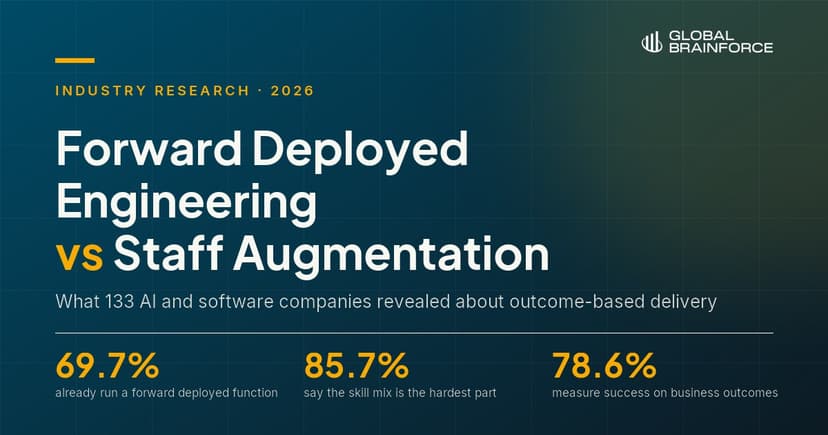
GoodFirms surveyed 133 AI and software companies on forward deployed engineering. The bottleneck is not code. It is commercial judgment.