Forward Deployed Engineering vs Staff Augmentation: What 133 Companies Told GoodFirms in 2026

Robert Giezen
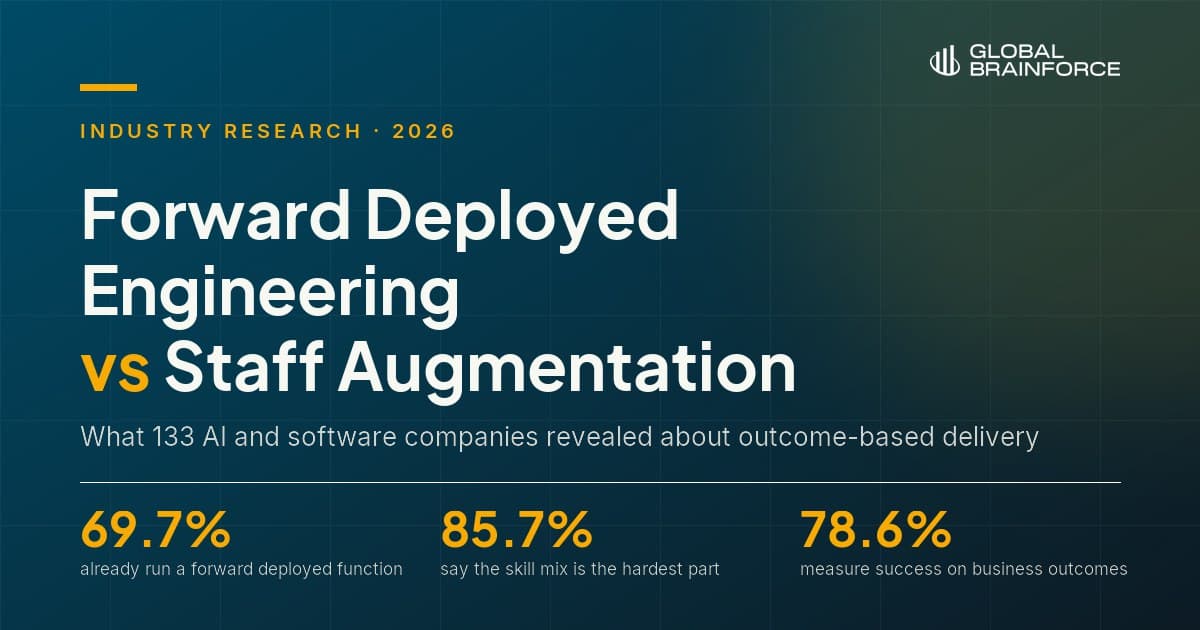
Global BrainForce contributed to a 2026 GoodFirms study on forward deployed engineering. GoodFirms surveyed 133 AI and software companies on how they staff client-facing engineering work, and published the findings in Forward Deployed Engineering vs IT Staff Augmentation: What 133 Companies Reveal in 2026.
Our contribution was one sentence about what is actually scarce:
It isn't finding the tech talent that is hardest, it's finding engineers who can hold a commercial conversation and push back on a client when they ask for something that isn't feasible.
That line is the whole argument of this article. The rest is the study's data, and what it means if you are buying engineering capacity in 2026.
What the Study Asked
GoodFirms asked 133 AI and software companies how they structure engineering work that sits close to the client: who does it, how it is measured, where it is delivered from, and what makes it hard to staff.
The headline number is that 69.7% of the surveyed organisations already operate some form of forward deployed engineering function. This is no longer an experiment run by a handful of AI companies. It is how a majority of the surveyed market now delivers.
The Bottleneck Is Judgment, Not Code
85.7% of respondents named the right skill mix as their primary challenge. Not headcount. Not cost. Not tooling. The mix.
This matches what we see every week. The supply of people who can write working software is larger than it has ever been, and AI has widened it further. The supply of people who can sit in a call with a client, understand what the business actually needs, and say "that will not work, here is what will" has not moved.
That second skill is not a personality trait. It is trainable, but it has to be trained deliberately: cross-cultural communication, requirement clarification, and the confidence to disagree with a paying client without damaging the relationship. Most staffing models never touch it, because most staffing models are measured on how fast a seat gets filled.
The study also found that 57.1% report AI lets an individual engineer deliver more. Both findings point the same way. When AI writes more of the code, the engineer's judgment, review and accountability become the product. The scarce input moves up the stack.
Outcomes Are Now the Contract
78.6% of the surveyed companies measure forward deployed engineering success on pre-agreed business results, not on activity, velocity or hours.
This is the structural difference between forward deployed engineering and classic IT staff augmentation. Staff augmentation supplies capacity and hands direction, quality and accountability back to the client. Forward deployed engineering supplies capacity and takes a share of the accountability.
It also changes what the buyer has to do before signing. If success is a pre-agreed business result, that result has to be defined, and someone has to own it. A vague outcome makes an outcome-based engagement worse, not better.
Remote Is the Default Delivery Shape
78.6% deploy their forward deployed engineers remotely while keeping tight integration with the client's team.
"Forward deployed" has never meant "on your floor". It means deployed into the client's context: their standups, their priorities, their decisions, their definition of done. The study confirms that the market has settled this question. What matters is proximity to the client's decision-making, not proximity to the client's office.
This is the model we have run since 2012. Our professionals work from the Philippines, inside the client's processes and tools, with the operational layer, HR, payroll, compliance, IT, performance, carried entirely by us.
The Salary Gap Is Not the Point
The study records a wide geographic spread in senior forward deployed engineer salaries: around $330,000 a year in the United States against roughly $20,000 in India.
A gap that size tempts buyers to treat the decision as arbitrage. That is the wrong read, and it is how offshore engagements fail. A cheaper engineer who cannot hold the commercial conversation does not deliver a cheaper outcome. They deliver a rebuilt outcome, six weeks later, with the client's own architect doing the thinking that was supposed to be bought.
The useful question is not what an engineer costs. It is whether the engagement includes the judgment layer, and who is accountable when the requirement was wrong.
What This Means If You Are Buying Engineering Capacity
Three practical tests, drawn straight from the study's findings:
- Ask who is accountable for the outcome. If the answer is "your team directs the work", you are buying capacity, which is a legitimate purchase, but price it as capacity. If you want a business result, the contract has to name that result.
- Screen for the conversation, not just the stack. 85.7% of the market says the skill mix is the hard part. A technical test alone will not surface whether an engineer can challenge a bad requirement.
- Stop treating remote as the compromise. 78.6% of the surveyed market deploys remotely and integrates tightly. The failure mode is weak integration, not distance.
How Global BrainForce Builds For This
Our screening covers six competency areas, and the sixth is Communication & Business Understanding: async collaboration, client-facing communication, requirement clarification, and proactive ownership. It carries the same weight as technical fundamentals, architecture, quality, DevOps and AI development skills. That is a deliberate answer to the bottleneck the study identified.
Our Engineering Pods take this further. A Pod is a pre-configured delivery unit with a tech lead, AI-enhanced engineers and DevOps, where Global BrainForce owns delivery and the client owns the roadmap. It is forward deployed engineering with the operational layer already solved, typically operational in 2 to 3 weeks.
Full study: Forward Deployed Engineering vs IT Staff Augmentation: What 133 Companies Reveal in 2026, GoodFirms, 2026.
Frequently Asked Questions
What is forward deployed engineering?
Forward deployed engineering places engineers directly alongside the client's team and holds them accountable for a business outcome rather than for completed tickets. The engineer clarifies the requirement, builds, and owns the result. GoodFirms' 2026 study found 69.7% of surveyed AI and software companies now operate some form of forward deployed engineering function.
How is forward deployed engineering different from IT staff augmentation?
Staff augmentation supplies capacity and leaves direction, quality and accountability with the client. Forward deployed engineering supplies capacity plus judgment: the engineer is measured on a pre-agreed business result. GoodFirms found 78.6% of companies measure forward deployed engineering success on pre-agreed business outcomes.
Can forward deployed engineers work remotely?
Yes. In the GoodFirms 2026 study, 78.6% of companies deploy forward deployed engineers remotely while keeping tight client integration. Proximity to the client's decisions matters more than proximity to the client's office.
Ready to build your managed IT team?
Stop worrying about HR, payroll, and compliance. Get fully managed IT professionals working in your time zone, dedicated exclusively to your projects.
Start your teamRelated Resources

2026 Philippine IT Staffing Benchmark Report: Data from 14 Years of Managed Teams
Robert Giezen
•2026-05-17
Real operational data from 14 years of building managed IT teams from the Philippines. Retention, timelines, costs, and role demand.

Global BrainForce Assures Absolute Acceleration of Your IT Business Transformation: GoodFirms
Robert Giezen
•2024-08-11
Read the GoodFirms interview with Strategic Advisor & Founder Robert Giezen on how Global BrainForce accelerates digital transformation for IT businesses.

Netherlands ICT Talent Crisis: 100,000+ Vacancies and Strategic Solutions
Robert Giezen
•2021-06-10
Explore solutions for the Netherlands' ICT talent crisis and 100,000+ vacancies through offshore development and global talent access.

Managing a Remote Development Team Across Time Zones: A Practical Guide
Robert Giezen
•2026-05-17
A practical guide to managing remote developers across time zones. Covers daily overlap, async communication, and sprint planning.