2026 Philippine IT Staffing Benchmark Report: Data from 14 Years of Managed Teams

Robert Giezen

About This Report
This benchmark report presents operational data from Global BrainForce's managed IT staffing practice, covering 14 years of building dedicated remote development teams from the Philippines for Western clients: primarily in the Netherlands, United Kingdom, Australia, and the United States.
The data in this report reflects real engagement metrics from our active client base as of May 2026. It is not derived from surveys, third-party research, or industry estimates. Every figure published here comes from our own operational records and is a number we stand behind publicly.
We publish this report because the Philippine IT staffing market lacks reliable operational benchmarks. Most published data covers the broader IT-BPO sector or reflects survey-based estimates. Data from a provider that has operated dedicated managed teams continuously since 2012: through multiple market cycles, a global pandemic, and the AI transition, provides a different kind of signal.
This report will be updated annually.
Retention: Low Attrition, Long Relationships
Global BrainForce annual developer attrition: 5%. Client retention: 95%, year over year.
These are the two figures we publish on our homepage and stand behind publicly. Attrition measures how many professionals leave their engagement in a year. Client retention measures how many clients continue with us from one year to the next.
Low attrition in offshore IT staffing is operationally significant. Industry-wide, developer turnover in offshore staffing arrangements is widely cited as one of the primary failure modes: the cost of replacing a developer mid-engagement includes recruitment time, knowledge transfer, onboarding delay, and the productivity dip that follows any team change. At scale, high turnover erodes the cost advantage that motivated the offshore arrangement in the first place.
Our attrition rate is an outcome of a deliberate operational model rather than a market condition. The dual belonging structure, in which each developer is embedded in the client's team while remaining an active member of the GBF community of IT professionals in the Philippines, addresses the two primary causes of offshore developer turnover: isolation from a professional peer group, and weak connection to the client organisation.
Developers who feel part of both worlds, the client's product team and the GBF professional community, have a stronger reason to stay than developers who exist in neither.
What low attrition means in practice:
For a client with a small dedicated team, 5% annual attrition means a replacement is the exception rather than a recurring event. For clients who have kept their teams with us for many years, the continuity of institutional knowledge this creates is a compounding advantage: developers who have worked on a codebase for years carry context that no onboarding process can replicate. When a replacement is needed, it is covered by our replacement guarantee and typically completed within 1–2 weeks.
Client Tenure: Relationships Measured in Years
Client relationships average multiple years, and our founding clients from 2012 are still active.
The oldest active engagement, a European technology company that has worked with Global BrainForce continuously since 2012, is now in its fourteenth year. Newer clients join every year, and many of them started with one or two developers and grew from there.
Client tenure is the metric we consider most indicative of operational quality in managed staffing. A client does not maintain a dedicated offshore team for many years because the initial price was attractive. They maintain it because the team delivers, the developers stay, and the operational overhead on the client side remains low. Cost is the reason companies start an offshore engagement. Operational reliability is the reason they continue it.
The 2012 engagement in context:
Our oldest active client has worked with Global BrainForce since 2012. Over that period, they have navigated multiple technology stack transitions, significant company growth, the COVID-19 pandemic, and the AI tooling transition, with their dedicated GBF team as a constant. That continuity of relationship and institutional knowledge is not something that can be reconstructed once lost. It is built over years of consistent delivery and operational reliability.
Deployment Timelines: Fast Track and Full Process
Global BrainForce deploys a dedicated professional in 2–3 weeks on the Fast Track, or 4–6 weeks on the full process.
| Route | Timeline | When it applies |
|---|---|---|
| Fast Track | 2–3 weeks | Common profiles, where we can present candidates quickly and the client interviews promptly |
| Full Process | 4–6 weeks | Custom recruitment for specialised profiles |
The Fast Track covers the profiles we recruit for most often, where candidates assessed against our 6-area framework can be presented quickly. Where the client runs a final round of interviews, that round sits inside the same window.
The full process involves custom recruitment for specialised profiles: senior AI/ML engineers, ERP specialists, principal-level cloud architects, or niche technology stacks.
For context: The typical time-to-hire for a senior software engineer in the Netherlands is 3–6 months, including job posting, screening, interviewing, offer negotiation, and notice period. A deployed, operational developer in 2–3 weeks shortens that cycle substantially.
This speed is only possible because the operational infrastructure: employment contracts, payroll setup, IT equipment, compliance onboarding, is handled by Global BrainForce rather than the client. A client engaging directly with a Philippine developer would face the same procurement and compliance timeline regardless of how quickly they identified a candidate.
Active Engagements: Scale and Structure
Global BrainForce has managed 200+ IT professionals across all IT roles since 2012, and clients from our first year are still active.
This structure reflects a deliberate positioning. We are not a high-volume placement operation. We are a managed staffing partner focused on long-term, deeply integrated engagements where operational reliability and team continuity matter more than throughput.
Our engagements follow the way European SMEs and scale-ups build offshore capacity. Most companies do not start with a team of ten. They start with one or two developers, validate the model, and scale from there. Several of our current clients began with a single developer and have grown their dedicated teams over multiple years.
Why boutique scale matters for quality:
At our current scale, every client engagement receives direct attention from senior operational staff. There are no account management layers, no junior coordinators handling escalations, and no situations where a client's team is managed by someone who does not know the engagement history. When a client has a question or a concern, they reach the people who can resolve it, same day.
This is the speedboat model in practice. It is not a marketing positioning. It is a structural outcome of operating at a scale where every engagement matters.
Relationships measured in years:
Client relationships average multiple years, and the clients who started with us in 2012 are still with us. That continuity is what we manage to, not headcount growth.
A Deliberate Choice: Quality Over Volume
We could operate differently. The Philippine IT market has 1.82 million IT professionals. A company with our market position and operational infrastructure could place hundreds of developers per year by selecting primarily on cost, filling seats quickly with the most affordable candidates available and moving on to the next placement.
We have chosen not to do that.
Our selection process filters on technical depth, English communication quality, professional maturity, and long-term fit with the client's team culture. We reject candidates that a volume-focused provider would place. The result is a selective, IT-only base of professionals who are genuinely performing at a level that justifies long-term client relationships.
This is a business model choice, not a capacity constraint. It means we are the wrong partner for companies whose primary criterion is the lowest possible monthly rate. It means we are the right partner for companies that have learned, often through experience with cheaper alternatives, that the true cost of a low-quality or high-turnover offshore arrangement exceeds the cost of doing it properly from the start.
Client relationships average multiple years, and our oldest client has been with us since 2012. That is only possible if the developers we place are genuinely good, and if the operational model around them keeps them stable, motivated, and growing.
We are selective about who we place because our clients are selective about who they work with. That alignment is the foundation of every long-term engagement we have built.
Role Demand: Most Requested Profiles
Most requested profile: Full-stack developer with .NET backend and React frontend.
The .NET + React combination has been the most consistently requested profile across our European client base for multiple years. It reflects the technology stack reality of Dutch and broader European enterprise software companies, a large installed base of .NET backend systems, increasingly paired with modern React frontends as companies modernise their user interfaces without replacing their core backend infrastructure.
Current demand by category across active engagements:
| Role Category | Demand Level |
|---|---|
| Full-stack (.NET + React) | Highest |
| Java / Spring Boot | High |
| DevOps / SRE | High |
| React / Frontend | Medium-High |
| Python / Data Engineering | Medium-High |
| QA / Test Automation | Medium |
| IT Support / SysAdmin | Medium |
| PHP / Laravel | Medium |
| ERP / SAP Consultants | Lower, specialist |
Emerging demand in 2026:
AI-enabled developer profiles: developers with demonstrable experience integrating LLM APIs, building AI-assisted features, or working with tools like GitHub Copilot at a team-wide level, are increasingly requested as a secondary qualifier alongside the primary technology stack. This is not yet a standalone role category in most engagements, but it is becoming a differentiating factor in candidate selection.
Cost Benchmarks: 2026 Fully Loaded Rates
The table below is rendered from our published rate card at every build, so it always shows the current rates. Every figure is a fully loaded monthly cost per professional in EUR (HR, payroll, Philippine statutory compliance, IT equipment, performance monitoring, account management and the replacement guarantee included), next to the local hiring cost for the same role and seniority in Europe.
| Role | Seniority | Local hire / month | Global BrainForce / month | You save |
|---|---|---|---|---|
| ERP / SAP Consultant | Mid (2–5 years) | EUR 5,000 | EUR 3,600 | 28% |
| ERP / SAP Consultant | Senior (5–8 years) | EUR 6,250 | EUR 4,700 | 25% |
| DevOps / Cloud / Platform | Mid (2–5 years) | EUR 5,400 | EUR 3,450 | 36% |
| DevOps / Cloud / Platform | Senior (5–8 years) | EUR 6,800 | EUR 4,450 | 35% |
| DevOps / Cloud / Platform | Lead / Architect (7+ years) | EUR 8,200 | EUR 6,200 | 24% |
| IT Support / SysAdmin | Mid (2–5 years) | EUR 4,200 | EUR 2,300 | 45% |
| IT Support / SysAdmin | Senior (5–8 years) | EUR 5,200 | EUR 2,800 | 46% |
| Microsoft 365 & Endpoint Administrator | Mid (2–5 years) | EUR 4,600 | EUR 2,500 | 46% |
| Microsoft 365 & Endpoint Administrator | Senior (5–8 years) | EUR 5,900 | EUR 3,200 | 46% |
| NOC Analyst | Mid (2–5 years) | EUR 4,200 | EUR 1,950 | 54% |
| NOC Analyst | Senior (5–8 years) | EUR 5,500 | EUR 2,250 | 59% |
| Service Desk Technician | Mid (2–5 years) | EUR 3,800 | EUR 1,400 | 63% |
| Service Desk Technician | Senior (5–8 years) | EUR 4,600 | EUR 1,800 | 61% |
| Delivery / Project Manager | Mid (2–5 years) | EUR 5,800 | EUR 3,350 | 42% |
| Data / AI Engineer | Mid (2–5 years) | EUR 6,500 | EUR 3,600 | 45% |
| Data / AI Engineer | Senior (5–8 years) | EUR 8,500 | EUR 4,700 | 45% |
| Data / AI Engineer | Lead / Architect (7+ years) | EUR 11,000 | EUR 7,050 | 36% |
| Delivery / Project Manager | Senior (5–8 years) | EUR 8,000 | EUR 4,150 | 48% |
| Delivery / Project Manager | Lead / Architect (7+ years) | EUR 10,000 | EUR 6,200 | 38% |
| QA / Test Engineer | Mid (2–5 years) | EUR 5,000 | EUR 2,450 | 51% |
| QA / Test Engineer | Senior (5–8 years) | EUR 6,250 | EUR 3,450 | 45% |
| QA / Test Engineer | Lead / Architect (7+ years) | EUR 7,500 | EUR 4,850 | 35% |
| Software Engineer | Mid (2–5 years) | EUR 5,400 | EUR 3,200 | 41% |
| Software Engineer | Senior (5–8 years) | EUR 7,900 | EUR 4,000 | 49% |
| Software Engineer | Lead / Architect (7+ years) | EUR 9,200 | EUR 6,100 | 34% |
| Solution Architect / Tech Lead | Senior (5–8 years) | EUR 9,000 | EUR 4,850 | 46% |
| Solution Architect / Tech Lead | Lead / Architect (7+ years) | EUR 11,000 | EUR 7,300 | 34% |
Monthly cost per remote professional for Europe, in EUR. The Global BrainForce column is the full managed cost: salary, HR, payroll, IT, compliance and support, no separate management fee. Average saving across these roles: 45%. Final rates are confirmed once you have selected the professional. Rates published October 2026. Get matched
Cost differential: European clients working with Global BrainForce typically reduce their development staffing cost by 35-50% compared to equivalent local hiring. For a senior software engineer, the saving is EUR 46,800 per year.
The most common entry point for European clients is a mid-level full-stack developer: the profile that offers the most immediate productivity relative to cost, and the clearest path to expanding the engagement once the working relationship is established.
What the Data Tells Us About the Market in 2026
Three patterns emerge clearly from fourteen years of operational data:
Retention is the defining quality metric, not recruitment speed.
Companies that evaluate offshore staffing providers primarily on time-to-hire are optimising for the wrong variable. Recruitment speed matters, but a developer who joins in two weeks and leaves in eight months costs more: in lost productivity, knowledge transfer, and re-recruitment, than a developer who took four weeks to place and stayed for four years. Our 5% annual attrition reflects an operational model built around keeping developers, not just placing them.
The clients who stay longest started with the clearest integration intent.
Our longest-tenured clients did not engage us as a cost experiment. They engaged us because they needed genuine development capacity, people who would become part of their team, and they invested in the onboarding, communication protocols, and relationship-building that makes distributed teams work. The cost saving was a consequence of the decision, not the primary motivation. The clients for whom cost is the only motivation tend to have shorter engagements and higher turnover.
The AI transition is changing role requirements, not role volume.
The arrival of AI coding tools: GitHub Copilot, ChatGPT, Claude, has not reduced demand for dedicated developers among our client base. It has changed the profile of what makes a developer effective. Developers who use AI tooling fluently, not as a novelty but as a genuine productivity multiplier integrated into their workflow, deliver measurably more output per sprint than developers who do not. We actively support AI tool adoption across our developer community, and it is increasingly a factor in how we assess and present candidates.
Methodology Notes
Attrition and client retention: Annual developer attrition and year-over-year client retention, the same figures published on our homepage.
Client tenure: Based on currently active client relationships, including the founding clients who have been with us since 2012.
Deployment timelines: Our standard Fast Track and full-process timelines. The full process applies to engagements requiring custom recruitment for specialist profiles.
Cost benchmarks: Based on Global BrainForce 2026 pricing for European clients. Western European comparison figures are estimates based on publicly available salary data and standard employer cost calculations for the Netherlands, Germany, United Kingdom, and Australia. Individual costs vary by company size, location, benefits structure, and role seniority within each band.
Active engagements: Figures as of May 2026. Reflects currently managed, active developer placements. Historical figure of 200+ reflects all IT professionals managed since founding.
Global BrainForce, Managing dedicated IT teams from the Philippines since 2012. globalbrainforce.com | info@globalbrainforce.com
Ready to build your managed IT team?
Stop worrying about HR, payroll, and compliance. Get fully managed IT professionals working in your time zone, dedicated exclusively to your projects.
Start your teamRelated Resources

Managed IT Staffing vs IT Outsourcing: What's the Difference?
Robert Giezen
•2026-05-17
Managed IT staffing vs IT outsourcing: understand the key differences, who each model is right for, and why it matters for building development capacity.

Philippines Developer Cost for European Companies: 2026 Pricing Guide
Robert Giezen
•2026-05-17
2026 monthly cost of a dedicated developer from the Philippines for European companies, per role and seniority, next to the local hiring cost.
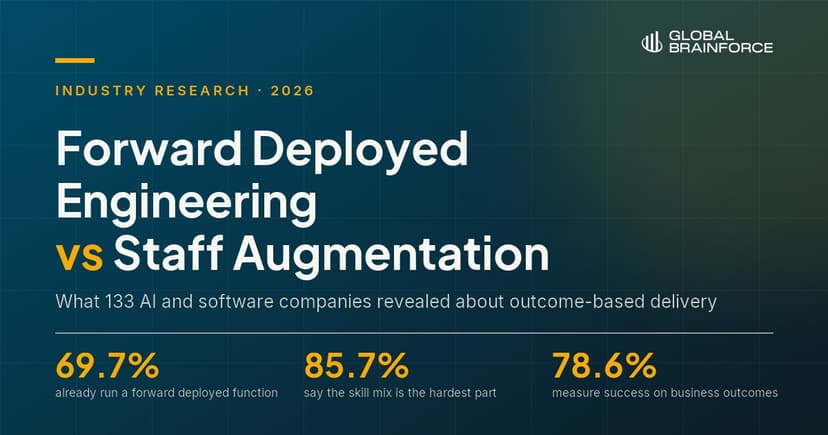
Forward Deployed Engineering vs Staff Augmentation: What 133 Companies Told GoodFirms in 2026
Robert Giezen
•2026-09-14
GoodFirms surveyed 133 AI and software companies on forward deployed engineering. The bottleneck is not code. It is commercial judgment.

Managing a Remote Development Team Across Time Zones: A Practical Guide
Robert Giezen
•2026-05-17
A practical guide to managing remote developers across time zones. Covers daily overlap, async communication, and sprint planning.