IT Outsourcing in the Netherlands: Market Overview and Provider Guide (2026)

Robert Giezen

The Dutch IT Outsourcing Market in 2026
The Netherlands has one of the most acute IT talent shortages in Europe. With over 100,000 open ICT vacancies and a domestic technology sector that continues to grow faster than the local talent supply can support, Dutch companies across every industry: from fintech and e-commerce to logistics, healthcare, and manufacturing, are increasingly turning to international IT talent to fill the gap.
IT outsourcing for Dutch companies in 2026 broadly means one of three things: contracting a vendor to deliver a defined project, engaging a nearshore partner in Eastern Europe, or building a dedicated offshore team, typically in Asia, managed by an operational partner. Each model has different cost structures, integration levels, and risk profiles. This guide explains the landscape and what to consider when evaluating options.
Why Dutch Companies Outsource IT
The primary driver is straightforward: there are not enough qualified IT professionals in the Netherlands to meet demand at a price point that allows Dutch companies to remain competitive.
The Dutch ICT labour market in 2026 is characterised by:
Structural talent shortage. The gap between ICT vacancies and available candidates has persisted and widened over the past decade. Universities and HBO programmes produce significantly fewer graduates than the market absorbs each year, and immigration of international IT professionals, while meaningful, has not closed the gap.
High local employment costs. A senior software engineer in the Netherlands costs €8,000–€13,000 per month all-in when employer taxes, pension contributions, holiday allowance, equipment, recruitment costs, and management overhead are included. For scale-ups and mid-size companies, this makes building large internal engineering teams economically difficult.
Competition from large enterprises. Dutch SMEs and scale-ups compete for the same local talent pool as ASML, Booking.com, Adyen, and the Amsterdam offices of global technology companies, at a significant disadvantage on compensation and brand recognition.
Speed of hiring. Local hiring timelines for senior technical roles in the Netherlands routinely run three to six months from job posting to start date. For companies with product roadmap pressure, that timeline creates real business risk.
IT outsourcing, in one of its forms, addresses all four of these constraints simultaneously.
The Main Outsourcing Models Available to Dutch Companies
Project-based outsourcing A vendor takes ownership of a defined deliverable: a new product feature, a system integration, a data migration. You define the requirements and acceptance criteria; the vendor manages the team and the delivery. This model works well for bounded projects but does not build internal capability or institutional knowledge.
Nearshore staffing Contractors or small teams based in Eastern Europe: Poland, Romania, Ukraine, Czech Republic: work on your projects, typically on a time-and-materials basis. Geographic and timezone proximity is an advantage. Rates are lower than D
Ready to build your managed IT team?
Stop worrying about HR, payroll, and compliance. Get fully managed IT professionals working in your time zone, dedicated exclusively to your projects.
Start your teamRelated Resources

Philippines Developer Cost for European Companies: 2026 Pricing Guide
Robert Giezen
•2026-05-17
2026 fully loaded pricing for dedicated developers from the Philippines for European companies. Includes ranges by seniority and local hiring comparisons.

GDPR and Offshore Development: A Practical Guide for Dutch and German Companies
Robert Giezen
•2026-05-17
A practical guide to GDPR compliance for European companies using offshore developers in the Philippines. Covers DPAs, SCCs, and data transfer verification.

2026 Philippine IT Staffing Benchmark Report: Data from 14 Years of Managed Teams
Robert Giezen
•2026-05-17
Real operational data from 14 years of building managed IT teams from the Philippines. Retention, timelines, costs, and role demand.
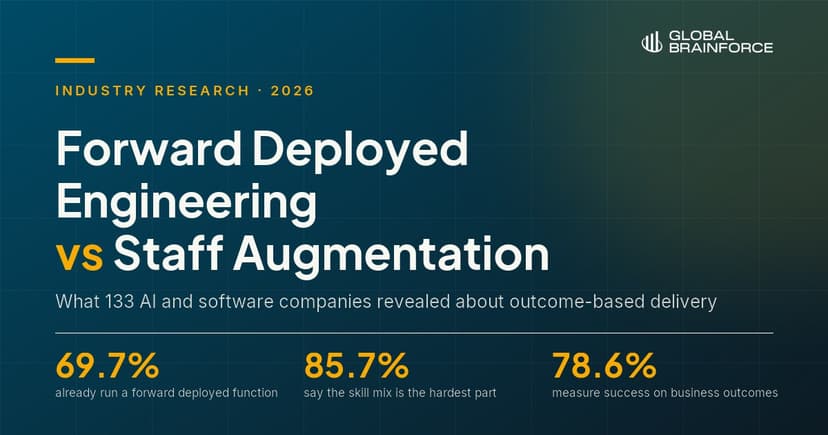
Forward Deployed Engineering vs Staff Augmentation: What 133 Companies Told GoodFirms in 2026
Robert Giezen
•2026-09-14
GoodFirms surveyed 133 AI and software companies on forward deployed engineering. The bottleneck is not code. It is commercial judgment.